The Essence of the Bhagavad Gita: Complete Surrender

What does the entire Bhagavad Gita teach? In the very first chapter, Arjuna says, “ if I kill all these people, I will incur sin; I will go to hell. I will not fight.” Bhagavan Shri Krishna replied: hato vā prāpsyasi svargaṁ (2.37) — “If you are killed, you will attain heaven; if you win, you will enjoy the kingdom of earth.” Arjuna thought, “In this mortal world we are already seeing that there is no real happiness. And You have already explained that there is no true happiness even in heaven — te taṁ bhuktvā svarga-lokaṁ (9.21). Then why should I fight?” Bhagavan then delivered the entire teaching of the Gita’s eighteen chapters. He explained Vedanta, Nyaya, Sankhya, Mimamsa, Patanjali, and Vaisheshika — all Darshan Shastras. But Arjuna was still confused.
Finally, in the eighteenth chapter, in verse 64, Bhagavan said, “Now listen. Beyond this I will not speak.” sarva-guhyataraṁ bhūyaḥ — “The most confidential instruction.” Arjuna became alert, wondering, “What is He going to say now?” Shri Krishna continued in 18.65: man-manā bhava mad-bhakto mad-yājī māṁ namaskuru — “Fix your mind on Me. Worship Me alone. Offer your love to Me.” — Only devotion to Him. Do not listen to anything else; do not read anything else; do not think of anything else. But Arjuna still had fear of sin. He kept thinking, “Everything is fine, but this is murder.” Then Shri Krishna revealed the ultimate instruction in 18.66: sarva-dharmān parityajya mām ekaṁ śaraṇaṁ vraja — “Abandon all dharmas whatever you hold in your mind, all concepts of sin and virtue. Come exclusively into My refuge, I will free you from all sins.” This is the law, even in the Vedas. Shri Krishna further said in 8.7: tasmāt sarveṣu kāleṣu māṁ anusmara yudhya ca — “Therefore, at all times remember Me and fight, keeping your mind constantly attached to Me.”
Arjuna was not fighting out of personal enmity. He was simply fulfilling the order of the Lord, having surrendered to Him. Thus, the physical action for Arjuna became fighting. But the action of the body is not what is counted by God. Arjuna killed millions in the war, Hanuman Ji destroyed millions in Lanka, yet God never counted any of that as sin because their minds were fixed on Him. If the mind is with God, then even if you multiply zero by a million, the result is still zero. Without the mind, no action is truly an action. Pay attention to this point, because it will be useful all the way to God-realization. What people commonly call devotion — chanting names even when the mind is not present — is only self-deception. The fruit is according to where the mind is attached. God states this at many places in scriptures: mana eva manuṣyāṇāṁ kāraṇaṁ bandha-mokṣayoḥ — The mind alone is the doer. If even once the mind is surrendered, without even uttering the name of God, that surrender alone is God-realization. We perform so many physical spiritual practices. God says, “Give Me your mind. With your body, perform your worldly duties.” But we do the opposite. We give our mind to the world, and with the senses we perform devotion: with the tongue, with the hands doing worship, with the feet marching to pilgrimages. Has any benefit come? None. Worldly attachment continues to increase. If a medicine brings no benefit, we ask the doctor. But we grow old performing worship, reading scriptures — Chalisa, Sundarkand, the Gita — and never question whether anything has happened from all this. The Gita says, “Surrender to God.” Then you must surrender. We merely repeat the same words. God says, “Perform My Devotion,” and we also say, “Perform My Devotion.” Reading words does not transform; only heartfelt devotion does. Your own experience matters — after chanting, reading, and worshipping for so many years, nothing has happened. Devotion must be performed with the mind — with tears and longing for Him. You must cry and call out to God. And keep no desire. This is the condition: do not ask for worldly gains; do not even ask for liberation; pray only for His vision, only for His love. If you approach God with any desire other than these two, you will become atheistic.
Consider this example: someone went to Vaishno Devi and asked for a son. A son was granted. Later the son fell ill; the doctor gave up hope. They again went to Vaishno Devi. They returned, and the son died. When the son was born, they believed it was the grace of Vaishno Devi. Then, when he died, they must accept this too happened by divine will. But people say, “There is no Vaishno Devi. So why ask God for worldly things? Countless times you have enjoyed all this: countless mothers, fathers, wives, husbands, sons, daughters; countless heavens; countless pleasures; yet you were never satisfied.
Once, Bhagavan Narayan went with Lakshmi to Indra in heaven. Indra welcomed them. Bhagavan said, “Ask for a boon.”
Indra replied, “Give me a woman of incomparable beauty.”
Bhagavan glanced at Lakshmi and smiled. He instructed Yogmaya, who instantly produced countless women. Bhagavan told Indra, “Choose one.”
Indra selected the very first — Urvashi. Bhagavan smiled and returned to His divine abode.
Indra then went to his Guru, Brihaspati, proudly saying,
“Guruji, Bhagavan Himself came and granted me this boon.”
Brihaspati replied, “Is this what you asked from God? You should have asked for His divine subjects. You have enjoyed worldly pleasures in infinite births — and now you have even brought shame upon your Guru.”
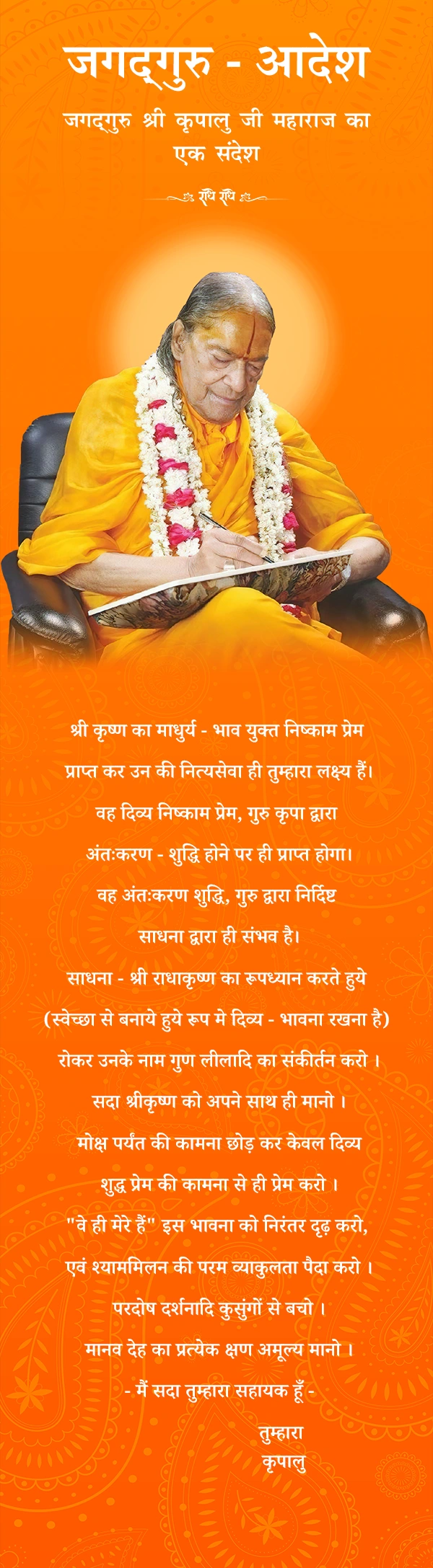
These worldly desires have ruined our infinite births. Give them up. Even if suffering comes, endure it. But do not ask from God or any deity, practice selfless Devotion — 1.Worship only Radha Krishna, 2. Do not desire anything, 3. Cry out to Them for Their love, darshan and nothing else. At all times and everywhere, realize that they reside in your heart. The Vedas and scriptures say so, suparṇāv etau sadṛśau — Bhagavatam, 11.11.6 and Ved Mantra — dvasu parna sauja sakhaya, declaring that He is seated in your heart always. Whether you get birth as a dog, He remains with you. Which Father follows his child into every birth? Only God. Realize this constantly. Then you are a true believer. We all say we believe in God; this means we must also believe that He resides in our heart. Everyone knows that. But do you realize Him? When you think something private, do you feel that He is noticing it? You forget Him. What kind of belief is that? Just as you are always conscious of yourself everywhere, in the same way constantly feel your eternal Father within you, He never leaves His son. Every half hour, remember, “He is sitting inside.” Then work. Again remember, “He is noting all my ideas every moment.” During those half hours you will not be able to think anything wrong, because you will remember that He is observing and punishment will come. We fear the world when we commit sins. But we do not fear God. We plan wrongdoing secretly. God notes only the thoughts of the mind. He does not note the external action. He gives fruits only according to the mind. That alone is called karma.
Therefore, bhakti is extremely simple. As Tulsidas says: kahahu bhagati path kavan prayāsā jog na yagya japa tapa makha upavāsā — There is no need for yoga, yajna, japa, austerity, sacrifice, or fasting. Prahlad also said that bhakti requires no effort. The Lord resides within every soul always, in all places, in all circumstances. Why call Him from outside? We call our parents or spouse from another room. But God is within us. Simply accept this. We do not accept it; We doubt it. We offer food to God by pouring a little water, closing our eyes for two seconds, and then begin eating. Is this offering? You are saying, “God, You eat first; then I will eat.” Have you ever checked whether God ate? But you assume, “God will not eat.” Then you are acting before God. At least you should have cried, “Even today He did not eat.
Remove these impurities of mind and practice to realize He is always with you. Stop the external ritualistic worship. Instead, perform Roopdhyan. Shed tears. Make His divine form mentally. Adorn Him the way you want, even offer Him a diamond or Kohinoor-like necklace mentally — imagine Him wearing it, and feel His divine beauty. The poor will say, “Where will we get diamonds?” But God says in the Bhagavatam, A mentally created form is fully accepted by Him: mano-mayī maṇi-mayī pratimāṣṭa-vidhā smṛtā. So worship the mental form created by the mind and keep Him always with you. No external material is needed. You worship stone idols physically. If one item is missing, you shout at others. Are you performing worship or becoming angry? So practice mental worship. By practicing this, gradually the inner being becomes purified. Then the Guru bestows divine love. In that very moment, God-realization occurs. Ignorance ends. The defects caused by Maya end. The three gunas end. The three karmas end. The five kleshas and the five koshas end. Our goal is attained: eternal freedom from suffering, eternal and infinite bliss, ever-increasing at every moment, forever.
This attainment is not impossible. If the practice is correct, it is extremely simple. There is no difficulty in bhakti, no trick, no deceit: mohi kapaṭa chhala chidra na bhāvā — Ramcharitmanas. When you were born, what effort did you make? What devotion did you perform? You cried. The mother understood, “The child is alive.” Whenever you needed something, hunger, stomach pain — you cried. The mother tried to understand and help. But the mother has limited knowledge. God is omniscient. If you surrender, He handles everything. When you grow older and begin doing something yourself, the mother stops doing it. When you do everything yourself, the mother does nothing. Similarly, when we act ourselves, God notes it and gives fruits accordingly. But when we surrender partially — 50 percent — He takes up 50 percent of our responsibilities. When we surrender completely, He carries all responsibilities for the welfare of those who depend exclusively on Him, as He promises: yoga-kṣemaṁ vahāmyaham (Gita 9.22). Then, according to the Subala Shruti: sadā paśyanti sūrayaḥ tad viṣṇoḥ paramaṁ padam — “We eternally behold and serve God in His divine abode.” Thus we attain eternal bliss.