
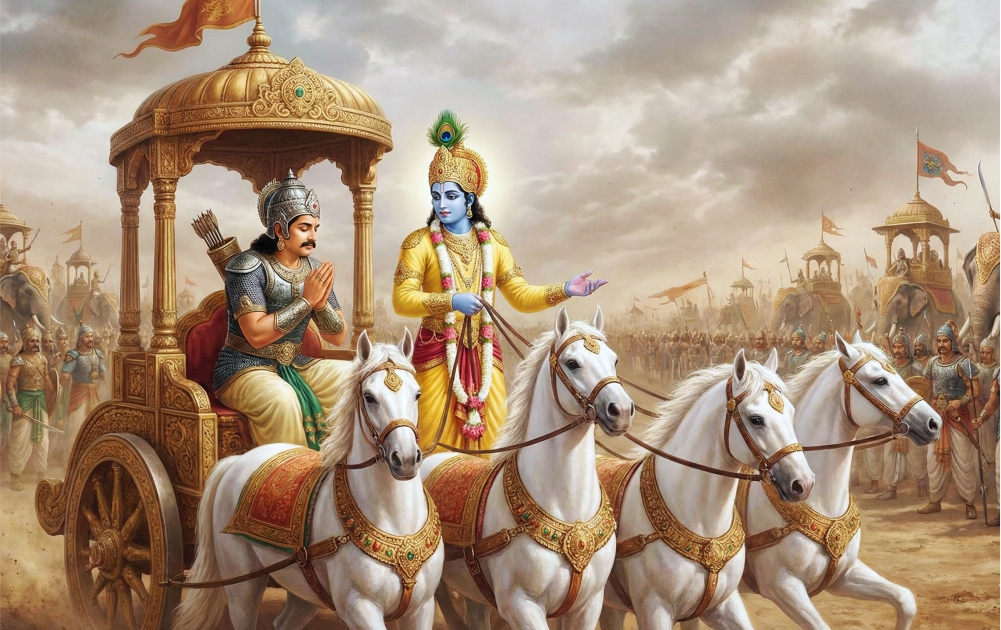
The meaning of karmayog can be understood through the Gitā. Lord Krishna instructs Arjuna,
tasmāt sarveṣhu kāleṣhu māmanusmara yuddhya cha (Gītā 8.7)
“Remember Me every moment while performing your duty.”
In other words, your mind should be constantly absorbed in loving remembrance of Shri Krishna, while performing other necessary duties. How should we practically follow this discipline of karmayog? This appears to be a serious problem because seeing with the eyes, or hearing with the ears and so on, is not possible without the involvement of the mind. Everyone experiences that if the mind is absorbed elsewhere, the senses are incapable of performing actions. How then can anyone engage in any action requiring total concentration, such as war, without the involvement of the mind and intellect, and at the same time remember God at every moment?
yo māṁ smarati nityashaḥ; teśhāṁ nityābhiyuktānām evam satatayuktā ye; teşhām satatayuktānām (Gītā)
All these verses in the Gītā insist that remembrance of God must be constant. Once the above question is resolved, the karmayog of the Gītā can be performed practically.
Let us reflect on this. There are two types of actions. First there are those actions in which the mind and intellect are involved and second there are those actions in which the mind and intellect are not only involved but also attached. If the difference between these two types of actions could be understood, then the secret behind practical karmayoga would immediately become clear. What I will explain here is not something new or unusual, but something you already understand. I will simply point it out to you.
Let us take an example of a faithful wife who is very attached to her husband. The husband returned to India from England after an absence of four years. The wife prepared various dishes for him and served him with great love when he arrived. When she asked him how he liked the food, he replied that it was very delicious. In the evening, she was unable to cook for some reason. So, she instructed the cook to prepare the meal. He cooked and served the food, and asked his master, “How is the meal?” The cook received the same praise as the wife.
Observe, even though the actions performed by the cook and the wife were the same, and the food prepared by both was equally tasty, nevertheless, there was a difference. The wife’s action not only involved the mind and intellect but included attachment to her husband, whereas the cook’s action involved the mind and intellect but was free from attachment to his master. How do we know this? After her husband had eaten, the wife went to her friend’s home dancing with joy and embraced her saying, “Today my husband came home.” But the cook said to his wife, “God alone knows, where he suddenly came from. It took me a full four hours to cook the food. I am completely exhausted. A cook’s job is the worst job in the world.” Now, because the wife was attached to her husband, she was also attached to the work she did for him. However, the cook was unattached to the master. He did the same work, but experienced no pleasure from it, because his attachment was elsewhere. It was to his own wife and family. Just as the cook was attached to his wife and children, and prepared the meal in a detached manner, you too have to lovingly attach your mind to God and, perform your worldly duties, without experiencing any pleasure from them.
A nurse and doctor are involved in the delivery of hundreds of babies in the hospital, but they experience no pleasure because they are emotionally unattached to all of them. The proof of this is seen when a baby dies. Then the nurse says to the parents, “I am sorry, I tried my best, but God willed otherwise. Please take the child now.” The mother is in a terrible state and is crying loudly. This was her only child, and it was stillborn. However, the nurse remains unaffected since she has no personal attachment. Handing the child over, she resumes her duties again. We have to perform our duties in this world like that nurse, without experiencing happiness or distress anywhere.
A cashier in a bank gives away millions of rupees every day without experiencing any distress. But, if he accidentally loses a single rupee note from his own salary, he becomes disturbed. He desperately tries to find it, cursing his own carelessness for losing it. However, he is not worried about the millions of rupees that go out of the bank every day that he personally disburses, because the money does not belong to him. It is public money; therefore, he has no attachment to it.
Let us take another example. Your neighbour’s son has died. The neighbour is crying, but you are sitting relaxed in your house, sipping your tea. You say to your wife, “Get me another cup I will have to go to the funeral. Who knows how long it will take.” You calmly finish breakfast, leave your house and put on an appropriate expression of sympathy on reaching your neighbour’s home. There you say, “How did such a terrible thing happen?” You go to the funeral and return tired and grumpy, “Of all days he chose to die today when I had planned to do so many things.” This is how you must perform work in the world without receiving pleasure from it. Use the mind and intellect, but remain detached.
Actually, all the activities that we perform indifferently, that we receive no pleasure from but we perform out of compulsion, involve the mind and intellect, but not attachment. Duties performed on a daily basis with this detachment constitute the larger portion of our activities.
—
Source
The above blog is an except from the following book authored by Jagadguru Shri Kripalu Ji Maharaj: Prem Ras Siddhant (4th Edition, March 2009); Chapter 13 – Practical Sadhana.
To learn more about Jagadguru Shri Kripalu Ji Maharaj’s literature, please visit –
https://jagadgurukripalujimaharaj.org.in/his-profound-literature/
Buy Prem Ras Siddhant (Hindi)
Buy Prem Ras Siddhant (English)
Buy Prem Ras Siddhant (English E-Book)